Adverse effect on the production performance of future generations.
Recent research examined the production performance and profitability of two future generations of cows born to mothers exposed to heat stress during pregnancy.
The results show that maternal hyperthermia during the end of gestation alters the daughters’ performance for multiple lactations. As we know, heat stress has a significant effect on dairy cows and a negative impact on milk production, reproductive performance, state of health of the herd and an increase in the obligatory reform. In the United States, this equates to losses of approximately 1.5 billion USD annually.
According to a study conducted in the United States, the impact of heat stress is long-lasting and continues to affect the performance of the offspring of a heat-stressed cow for two generations.
It has already been shown that cows born from heat-stressed cows during the last phase of pregnancy have lower growth and produce an average of 5 kg less milk per day in the first lactation.
Stress termico e un piano per l’estate: scarica la rivista
Anche se quest’anno si è fatta aspettare, la stagione calda è arrivata, e con lei tutti i problemi legati allo stress termico che possono interessare la mandria.
Puntuale arriva anche la rivista Tecnozoo dedicata al periodo estivo, in cui scoprire le migliori strategie in allevamento contro il caldo.
Oltre a questo articolo, in questo numero troverete:
Salute uterina durante i periodi estivi: valutiamo l’incidenza di metriti e endometriti (Ricerca presentata all’ADSA di Luglio 2019. (ADSA Abstract # 403).
Gestione della vitellaia: protocollo per affrontare al meglio il periodo estivo.
Production and reproductive performance of the two generations studied
The study conducted by Laporta et al., 2020 had two objectives 1) Measuring the carryover effect of maternal exposure to heat stress during the last period of pregnancy on milk production, reproductive performance and survival rate of daughters and grandchildren.
2) Estimating the economic losses related to these results in the U.S. Over 10 years, data were collected on the performance of Holstein cows in Florida, the US state that has the highest number of days of heat stress per year. Information was collected on the longevity, productivity and reproductive performance of 2 successive generations of cows born to mothers exposed to heat stress during pregnancy and those born to cooled mothers during the summer.
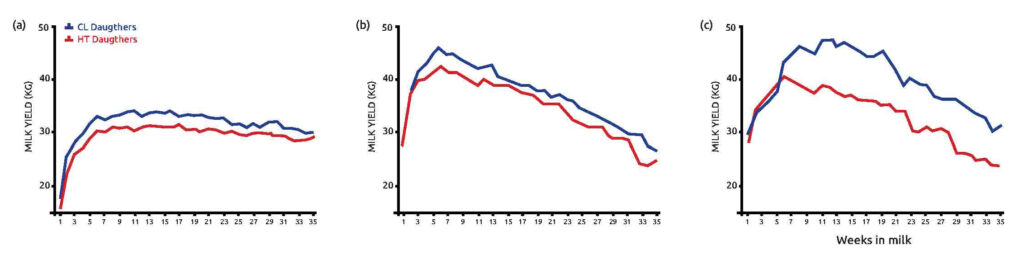
The cows in figure 1 were divided by calving order; the CL animals are the daughters born to mothers cooled in the last phase of pregnancy (~ 46 days) during thermal stress (shade, fans and showers), while the HT ones were born from cows that have had the only shadow. All cows were cooled during the three lactations. As can be seen, the loss of production is evident in all three lactations.
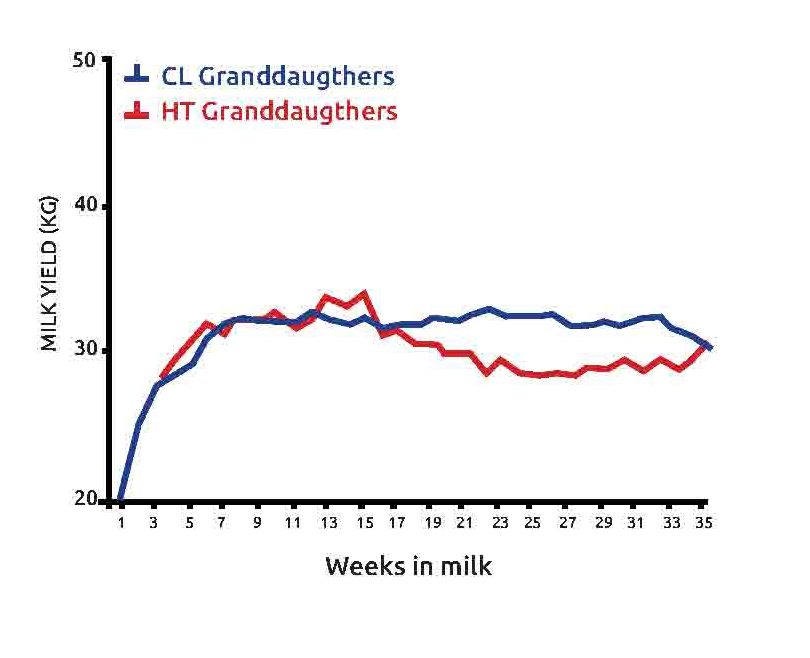
The daughters of cooled cows produced +2.2 kg / head / d in first lactation (31.4 vs 29.2); in second lactation +3.3 kg / head / d (36.7 vs 34.4); in third lactation +6.5 kg / head / d (39.6 vs 33.1). The persistence of production of the granddaughters (Figure 2) was also partially compromised, with a more pronounced decrease in the milk produced on the non-cooled ones. In an average herd in the United States with daughters (35% primiparous, 20% second lactation, and 14% third calving) born too late gestation heat stress cows, they lose 120 kg of milk per lactation.
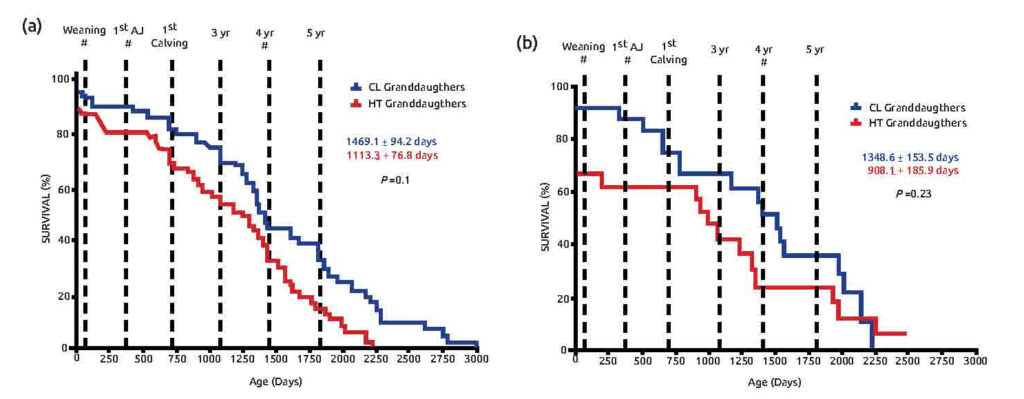
Daughters and grandchildren of cows in heat stress have shown adverse effects on survival rate (Figure 3) from birth to first calving, productive lifespan, production of milk and its components during the three lactations have translated into a considerable increase in costs for dairy farmers, with nationwide losses of up to $ 595 million annually.
This confirms the need to better manage heat stress even in dry cows. According to Laporta (Department of Animal Sciences – University of Florida), this research work suggests the presence of a permanent effect of the fetus/environment interaction on gene expression in adulthood.