THE IMPORTANCE OF VITAMINS IN THE POULTRY SECTOR
Vitamins are a diverse group of organic molecules required in small quantities by animals but essential for maintaining normal body functions, growth, and reproduction.
A deficiency in one or more vitamins can lead to a range of symptoms or deficiency syndromes that can severely impact production. Similarly, adequate vitamin intake is key to maintaining balance in an animal’s functions, especially during and after periods of illness or stress, to support the recovery of defenses and productivity.
LIPOSOLUBLE AND WATER-SOLUBLE VITAMINS
Vitamins are chemically divided into two categories: liposoluble (Vitamins A, D, E, and K) and water-soluble (Vitamin C and B vitamins).
Liposoluble vitamins are absorbed in the intestine in association with fats; therefore, the percentage of lipid inclusion in the feed also facilitates their absorption.
Moreover, liposoluble vitamins can be stored in the body’s adipose tissues, while water-soluble vitamins, except for B3 and B12, are not significantly stored in tissues, so a continuous dietary intake is necessary, especially during periods of increased need.
LIPOSOLUBLE VITAMINS
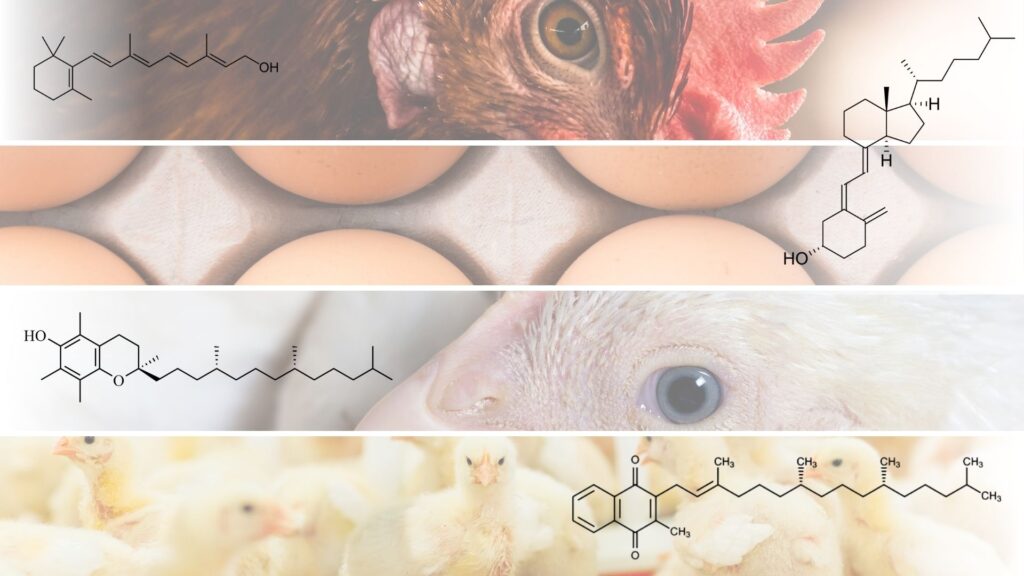
VITAMIN A
Vitamin A is essential for normal growth, reproduction, and maintenance of frequently regenerating epithelia such as those lining the digestive tract, respiratory tract, and genital tract.
Vitamin A and its derivatives, the retinoids, have a profound impact on organ development, cell proliferation, and differentiation.
Vitamin A is a hormone-like vitamin involved in regulating night vision.
Chicks hatched from eggs with low vitamin A content show stunted growth, ataxia, anorexia, and immunodepression within the first days.
In adults, there is keratinization of the epithelium lining the upper digestive tract (oral mucosa to the esophagus) and impairment of the epithelial turnover in the intestine, leading to a predisposition to enteritis.
In the eye, keratinization of the conjunctiva can occur, leading to blindness.
VITAMIN D
Vitamin D refers to a group of compounds including ergocalciferol (vitamin D2), cholecalciferol (vitamin D3), and their metabolites.
Vitamin D3 is necessary for the proper absorption and utilization of calcium and phosphorus, which are essential for bone mineralization and egg shell formation.
Cholecalciferol, which can be synthesized endogenously from cholesterol or obtained from the diet, undergoes two hydroxylations: the first in the liver to become 25-hydroxycholecalciferol, and the second in the kidneys to become 1,25-dihydroxycholecalciferol, the most active form of vitamin D (with 500-1000 times higher activity than its precursor).
Vitamin D deficiency syndrome is similar to calcium deficiency syndrome: tendency to immobility, signs of pain during movement, and may include joint swelling and deformation of the sternum, legs, and beak in growing birds. Laying hens produce eggs of reduced size with thin or absent shells.
Discover How to Improve Egg Shell Quality
VITAMIN E
The term vitamin E refers to a group of molecules with ahigh antioxidant power. Among these, the biologically most active molecule and the one most commonly used as a feed additive is D-α-tocopherol.
From a metabolic perspective, vitamin E does not undergo significant modifications but is integrated into the phospholipids of cellular membranes where it performs its antioxidant function.
This function is supported by enzymes whose cofactors are trace elements such as copper, manganese, zinc, iron, and selenium, which is why deficiencies in these elements increase the need for vitamin E.
Significant evidence suggests that there may be undiscovered metabolic roles for vitamin E, related to the roles of selenium and possibly other substances.
During the immune response, for example, the production of inflammatory mediators such as prostaglandin E2 can be influenced by the levels of available vitamin E, as well as the activity of certain phagocytes; therefore, vitamin E also has an immunomodulatory role. Deficiency leads to symptoms resulting from oxidative damage to cell membranes. More commonly reported are: encephalomalacia (with torticollis and ataxia), exudative diathesis in younger individuals, and dystrophy more commonly observed in adults.
VITAMIN K
Group of molecules with anti-hemorrhagic activity.
The simplest form of this group of molecules is menadione, the synthetic vitamin K3.
Vitamin K is essential for the synthesis of prothrombin, playing a key role in coagulation mechanisms.
The need for vitamin K increases during certain diseases, particularly those with a hemorrhagic nature, such as coccidiosis or verminosis.
The symptoms of vitamin K deficiency are related to the resulting poor blood coagulation. Cutaneous petechiae can be observed, especially on appendages exposed to trauma (legs and wings), chest petechiae, and an increase in blood spots in eggs.
Vitamin K has a high safety margin regarding overdosing. No side effects are reported even at doses 1000 times higher than the required amount.
WATER-SOLUBLE VITAMINS
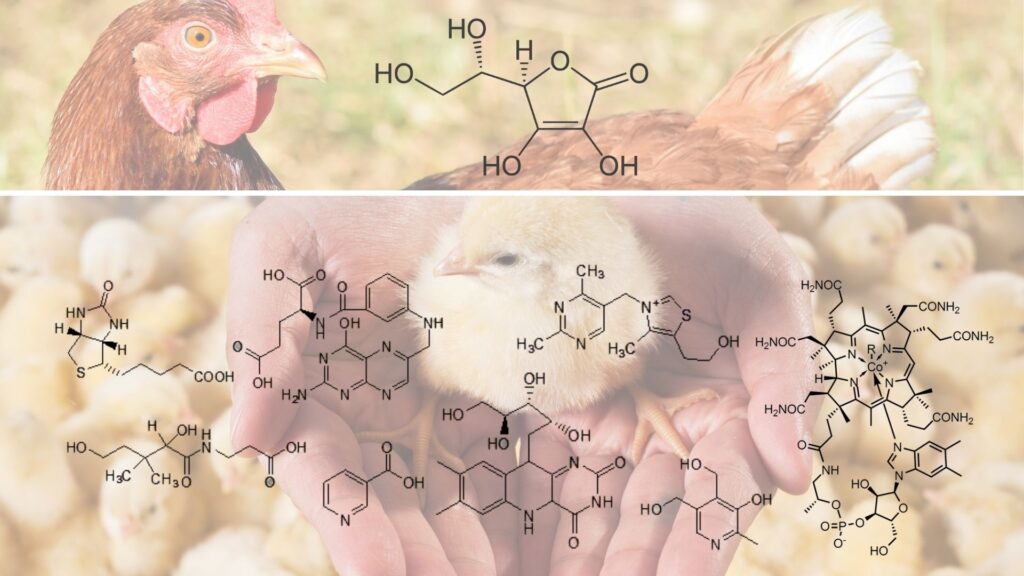
VITAMIN C
Domestic poultry do not have a real need for vitamin C because they can produce it autonomously from glucose.
Vitamin C plays an important antioxidant role: it is involved in numerous reactions within the body and works synergistically with vitamin E by regenerating its reducing power. Vitamin C is stored in the adrenal glands and released during times of stress when free radical production increases; in such cases, the need for vitamin C increases, and endogenous production may become insufficient. For example, during heat stress or pathological conditions, dietary supplementation is often necessary.
VITAMINE DEL GRUPPO B
The supplementation of B vitamins is generally used to compensate for the variable levels naturally present in foods and to ensure proper intake given their essential metabolic role. In general, B vitamins are involved at various levels in the primary metabolic processes of the animal, including energy metabolism.
| VITAMIN B1 – THIAMINE |
| Thiamine diphosphate is an important cofactor for enzymes involved in the metabolism of lipids, carbohydrates, and amino acids. In cases of thiamine deficiency, the catabolism of muscle tissue can meet the body’s needs for weeks in adult individuals, so deficiencies are rarely observed. Deficiency symptoms are primarily related to alterations in nervous system activity due to impaired energy metabolism: anorexia, weight loss, drooping wings, muscle paralysis, seizures, and opisthotonos (head in a “star-gazing” position). |
| VITAMIN B2 – RIBOFLAVIN |
| Riboflavin (vitamin B2) is part of oxidoreductase enzyme systems, so it plays a vital role in all metabolic processes. Diets high in proteins and lipids, such as those for poultry, require high riboflavin levels, and deficiency syndrome involves a drastic worsening of the conversion rate, reduced growth, occasional diarrhea, and perosis (deformation of the pelvic limbs). Affected birds walk on their hocks with the help of their wings. In laying hens, a reduction in egg production and eggs with very pale yolks are observed because riboflavin not only passes into the yolk but is also complexed by a protein in the albumen, which is responsible for the slightly yellowish color of the albumen. |
| VITAMIN B3 – NIACIN |
| Niacin, like riboflavin, is part of oxidoreductase enzyme systems, also playing a vital role in all metabolic processes. Niacin deficiency manifests as anorexia, stunted growth, inflammation of the oral cavity, dermatitis, and perosis; however, since endogenous synthesis from tryptophan is possible, deficiency phenomena are not common. |
| VITAMIN B6 – PYRIDOXINE |
| Pyridoxine is an essential cofactor for amino acid metabolism enzymes and regulates some enzymes involved in lipid metabolism. Diets with low protein content or unbalanced amino acid formulas require higher amounts of vitamin B6. Deficiency syndrome includes anorexia, anemia, perosis, tremors, and spasmodic convulsions with jerky movements. |
| VITAMIN B5 – PANTOTHENIC ACID |
| Pantothenic acid forms coenzyme A, a cofactor involved in the metabolism of carbohydrates, lipids, and amino acids. Stunted growth, weakness, and ruffled feathers are the initial deficiency symptoms. |
| VITAMIN B9 – FOLATES |
| Folate acts as enzyme cofactors in reactions involving the transfer of carbon units, such as nucleic acid synthesis and amino acid interconversion. Folate deficiency impairs DNA synthesis, affecting tissues with high turnover. The main symptoms are anemia, leukopenia, weakness, lethargy, dermatitis, and ruffled feathers. |
| VITAMIN B12 – CYANOCOBALAMIN |
| Cyanocobalamin (vitamin B12) is involved as a cofactor in enzymatic systems for nucleic acid synthesis, as well as in the metabolism of carbohydrates, lipids, and amino acids. Its deficiency causes slowed growth, erosions of the proventriculus, and hepatic steatosis. Note: Since cyanocobalamin also donates carbon units like folates or choline, it affects their mutual requirements. |
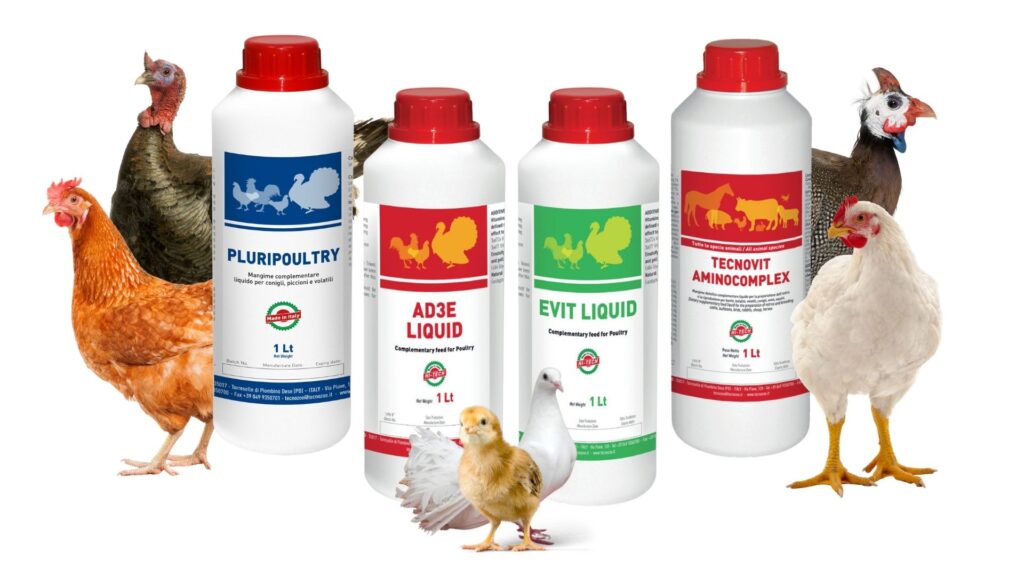
Tecnozoo, active in the livestock industry since 1984, has developed a line of multivitamin products designed to supplement the diet to prevent deficiency phenomena or during periods of increased requirements, such as during stress, in preparation for egg laying, and during production.