EGGSHELL FORMATION AND QUALITY
MANAGING CALCIUM REQUIREMENTS IN LAYING HENS BY CHOOSING THE IDEAL SOURCE
EGGSHELL CHARACTERISTICS
97-98% of the eggshell is composed of calcium carbonate.
The thickness of the shell depends on the amount of calcium deposited during its formation inside the uterus and the time the egg remains there (up to 15 hours).
From the moment the egg enters the uterus and shell deposition begins, there is an increase in the synthesis of active vitamin D and transport proteins at the intestinal level, doubling the absorption of calcium.
The calcium needed for shell deposition comes primarily from intestinal absorption and bone remodeling.
While in a hen fed a balanced diet with good calcium sources, dietary calcium is the primary source; in the case of inadequate or incorrect feed intake, a special bone matrix is mobilized, which forms in the laying hen under hormonal influence a couple of weeks before the start of egg laying and is in continuous remodeling.
This matrix can meet up to 40% of the calcium requirement when the animal is not feeding (thus not providing dietary calcium), such as during periods of darkness, stress, or when the diet is unbalanced.
HOW TO IMPROVE EGGSHELL QUALITY
Since a significant portion of eggshell synthesis occurs during the dark hours, the contribution of bone to shell formation is considered essential.
However, the greater the contribution of calcium from bone matrix remodeling, the thinner the eggshell becomes.
This is why inadequate calcium intake is compensated for but results in a less robust shell.
Factors influencing proper calcium intake include: the source, particle size, phosphorus content, and vitamin D levels.
Vitamin D, by regulating calcium absorption, is as important as calcium itself.
High levels of phosphorus inhibit intestinal calcium absorption and its mobilization from the bone matrix. To ensure proper calcium absorption, it is important to maintain the calcium-phosphorus ratio at 4:1 during laying.
An acidic intestinal pH maximizes the absorption of calcium and phosphorus; for this reason, acidifying the diet with organic acids plays an important role in laying hens.
CALCIUM SOURCES
- CALCIUM CARBONATE
It is the least expensive calcium source and can be either extracted or synthetic.
The important thing to remember when choosing this source is the particle size. Finely ground limestone is absorbed quickly, making it useful for rapidly replenishing the hen’s bone matrix or during eggshell formation if the hen is feeding. However, since this process occurs mostly during the dark hours, it is advisable to provide coarser particles that will remain in the gastrointestinal tract longer.
A 60:40 ratio of coarse to fine particles is recommended.
The solubility of limestone also plays an important role in calcium assimilation and depends on intestinal pH: the more acidic the intestinal pH, the greater the solubility. - OYSTER SHELLS / SHELL GRIT
A source of calcium carbonate derived from the crushing of bivalve mollusk shells. The particle size of this source and its composition delay solubility by 5-10 times compared to synthetic calcium carbonate. - CALCAREOUS SEAWEED
Seaweed contains pigments, vitamins, prebiotics in the form of complex carbohydrates, and chelated micro-minerals.
Therefore, calcareous seaweed is not just a source of calcium.
In addition to providing readily absorbable organic calcium, it contains substances involved in maintaining intestinal health, immune status, and egg quality.
Studies conducted on the use of certain seaweed species (Sargassum spp.) as a dietary supplement have shown an improvement in both the internal and external quality of eggs (lower cholesterol levels, more colored yolks, stronger and more pigmented shells). - CALCIUM GLUCONATE
An organic calcium source recommended in cases of deficiencies, environmental or managerial stress, as it is highly bioavailable.
During the digestive process, calcium gluconate releases gluconic acid, a molecule that supports calcium metabolism and energy metabolism in stress situations (heat stress, excessive bone mobilization, or decreased egg production syndrome), which can affect production levels or product quality. - CALCIUM PIDOLATE
An organic calcium source where calcium is bound to two molecules of pidolic acid.
This source has a dual function, providing both calcium and amino acids for protein synthesis.
Pidolic acid is indeed the substrate for the production of the amino acids arginine and proline, which are essential components of calcium transport proteins and collagen: a constituent of bone and the inner membrane of the eggshell.
This source is recommended during periods of stress or with advancing age of the hen, when calcium absorption and mobilization capacity decline.
It is reported that after 40 weeks, the ability to metabolize calcium decreases by 50%.
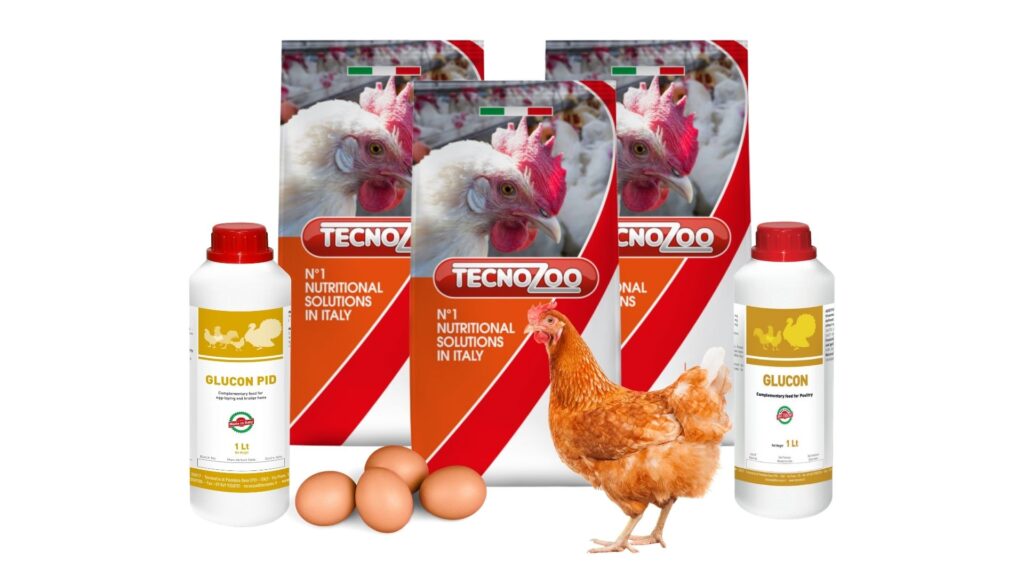
Tecnozoo has developed various solutions to address the issue of eggshell quality at every stage of the production cycle and during periods of stress.
Tecnozoo offers liquid or powder complementary feeds with carefully studied and selected calcium sources to meet all your needs.
Discover all the products for eggshell quality – https://tecnozoo.it/categoria-prodotto/avicoli/qualita-guscio/
Follow us on Instagram – https://www.instagram.com/tecnozoo/?hl=it
BIBLIOGRAPHY
- https://www.unaitalia.com/il-giusto-livello-di-calcio-per-le-ovaiole
- https://web.terzi.it/zootecnia-2/
- R. Joshi D. N. Desai A. S. Ranade P. E. Avari – “Effect of Calcium Pidolate on Egg
- Production and Egg Quality during Last Phase of Production Cycle with Reducing Levels of Inorganic Calcium”
- W. WASHBURN – “Incidence, Cause, and Prevention of Egg Shell Breakage in Commercial Production”
- https://www.ncbi.nlm.nih.gov/books/NBK232332/ – Effect of Environment on Nutrient Requirements of Domestic Animals.
- https://thepoultrysite.com/articles/factors-influencing-shell-quality
- Elaroussi et al. – “Calcium homeostasis in the laying hen. Age and dietary calcium effects”
- Olubunmi Gabriel Fasanmi – “Therapeutic Importance of Calcium Gluconate r in Cage Layer Fatigue (CLF), the Effects on Egg Production, Haematology and Serum Biochemistry of Commercial Layers”
- Al-Zahrani et al. – “The effect of supplementation of two levels of calcium pidolate and two levels of 25- hydroxycholechaciferol on egg quality in commercial laying hens”
- Gilles Tran et al – “Seaweeds for livestock diets: A review”
- Rosie Burgin – “Benefits of seaweed in poultry diets”
- Heuzé V., Tran G., Giger-Reverdin S., Lessire M., Lebas F., 2017 – Seaweeds (marine macroalgae)