KNOWING ORGANIC ACIDS AND THEIR PROPERTIES
It is estimated that in the poultry sector, feed represents more than half of the production costs, but why define it as a cost?
Feed actually represents an investment in production, and as a good entrepreneur would say, every investment should yield returns.
To make the most of the feed expenditure, it is necessary to increase feed efficiency, which means reducing the conversion ratio.
The group’s performance and thus your economy strongly depend on this, and this is only possible if you maintain the intestinal health of your animals.
Several studies show how dietary acidification not only has a well-known antimicrobial activity but also provides significant benefits to intestinal health.
Acidification promotes the digestion of food, its utilization, and the development of a healthy intestinal microbial flora (microbiota).
Acidifying preserves intestinal health, the health of the animal, and your finances.
ORGANIC ACIDS: A BRIEF CHEMISTRY LESSON BEFORE WE BEGIN
Organic acids or carboxylic acids (R-COOH) dissociate in aqueous solution into hydrogen ions (H+) and the corresponding anion (R-COO–).
The degree of dissociation (i.e., the loss of a hydrogen ion H+ from the -COOH functional group) is defined by the pKa of the acid, which is the acid dissociation constant.
The lower the pKa, the greater the ability to release hydrogen ions and thus acidify the environment.
| ACID | Formula | pKa at 25°C |
| Formic Acid | H-COOH | 3,75 |
| Acetic Acid | CH3-COOH | 4,75 |
| Propionic Acid | CH3-CH2-COOH | 4.87 |
| Butyric Acid | CH3-CH2-CH2-COOH | 4,82 |
| Lactic Acid | CH3-CHOH-COOH | 3.08 |
| Fumaric Acid | COOH-CH=CH-COOH | 3.03/4.44 |
| Citric Acid | COOH-CH2-C(OH)COOH-CH2-COOH | 3.14/5.95/6.39 |
THE PROPERTIES OF ORGANIC ACIDS:
ANTIMICROBIAL PROPERTIES
The main pathogenic bacteria: E. coli, Salmonella, and Clostridium perfringens cease to multiply at pH levels below 5 (i.e., in an acidic environment), while only acidophilic bacteria (Lactobacillus spp.) continue their replication.
The mechanism is quite simple: the undissociated form of the acid R-COOH is capable of penetrating the semi-permeable membrane of the bacterial cell. Once inside the cell, R-COOH dissociates, releasing H+ ions and thus acidifying the cytoplasm.
The cell, to restore the optimal pH, must extrude all the H+ ions present and to do so requires enzymatic systems that need energy. This results in a energy deprivation of the bacterial cell, which will lead to its death.
| Formic Acid | Yeasts and bacteria (E. coli and Salmonella spp.) |
| Acetic Acid | Bacteria (various species) |
| Propionic Acid | Molds |
| Butyric Acid | Bacteria (especially E. coli and Salmonella spp.) |
| Lactic Acid | Bacteria (various species) |
| Citric Acid | Bacteria (various species) |
The pKa and the chemical properties of acidic molecules confer varying degrees of antimicrobial power not only against different types of bacteria but also fungi and/or yeasts. Below is a brief overview of the action spectrum of the main organic acids.
EFFECTS ON PROTEIN DIGESTION
Proteins play an essential role in the body: enzymes, hormones, carrier molecules; whether it’s for growth, egg production, the ability to respond to infections, or adapting to stressful conditions, proteins are fundamental.
When formulating a diet, the goal is always to provide the animal with an adequate level of high biological value proteins, that is, proteins where the quality and ratio of essential amino acids (those that the animal cannot produce) are high.
However, ensuring the right protein intake for the animal is not only about providing a good source of protein but also ensuring proper digestion and absorption.
Proteins undergo partial digestion in the stomach by the enzyme pepsin, which is completed in the duodenum by pancreatic enzymes.
Pepsin needs to be in an acidic environment to work effectively, which is why acidifying the diet helps to promote protein digestion.
The action of the acid not only promotes the proteolytic activity of pepsin but also involves denaturation, which modifies the protein structure and further enhances the action of pepsin.
In young animals (especially in the first days after hatching) stomach acid production is limited, therefore, acidifying the diet from the very first days will promote protein digestion and thus chick development, while in adults it will enhance production.
The anions (R-COO–) released from acid dissociation also play an important role. It has been shown that by binding to calcium, zinc, and other cations, they promote the absorption of these essential minerals for the animal’s metabolism.
MODULATION OF INTESTINAL MICROBIOTA
It is known that organic acids significantly reduce the presence of pathogenic bacteria and increase the load of beneficial bacteria such as Lactobacillus spp.
Organic acids have a modulatory effect on the intestinal bacterial flora (microbiota). By promoting the development of non-pathogenic strains that colonize the intestinal epithelium, they prevent the adhesion of pathogenic bacteria introduced through the diet. This phenomenon is referred to as competitive exclusion.
Thus, there is not only a direct action on the bacterial cell but also an indirect action against its adhesion to the intestinal epithelium.
Effects on the Gastrointestinal System
Several studies report that combinations of organic acids supplemented in the diet have a trophic/plastic effect on the intestinal epithelium, promoting the development of villi and Lieberkühn crypts (structures involved in nutrient absorption, production of protective mucus, and essential molecules for digestion and defense against potential pathogens). This property appears to stem from an indirect effect of these acids’ antimicrobial action. The action of pathogenic bacteria and their toxins, which alter normal intestinal permeability causing transit alterations and impaired nutrient absorption, leading to diarrhea or similar episodes (“indigestion,” etc.), is reduced.
The modulatory action on the microbiota that populates the intestine prevents the colonization of potential pathogens and the onset of inflammatory or sub-inflammatory states, which can lead to chronic inflammation with permanent alterations in intestinal functionality that we have seen as fundamental to your production.
Studies on the performance of broilers and layers report that production benefits positively from the action of various combinations of organic acids.
Tecnozoo has studied the best combinations of acids for you because we know how important the intestinal health of your animals is.
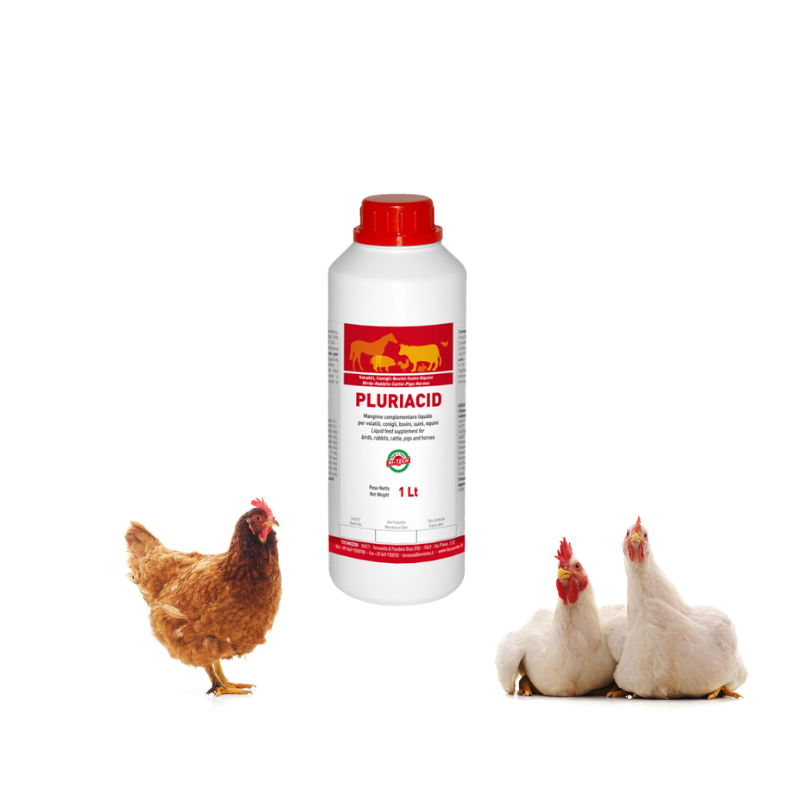
Looking for a complete product to acidify water? Try Pluriacid
BIBLIOGRAPHY
- Dr Srijit Tripathi – “Role of Acidifiers in Poultry”
- Beulah Vermilion Pearlin, Shanmathy Muthuvel, Prabakar Govidasamy, Manojkumar Villavan, Mahmoud Alagawany, Mayada Ragab Farag, Kuldeep Dhama, Marappan Gopi – “Role of acidifiers in livestock nutrition and health: A review”
- Sohail Hassan Khana and Javid Iqbalb – “Recent advances in the role of organic acids in poultry nutrition”
- Uk Essays – “Role Of Acidifier In Poultry Biology Essay”
- Avitechnutritions – “The Role of Acidifers in Poultry Nutrition”
- Salah Esmail – “Understanding protein requirements”
- D M Matthews and L Laster – “Absorption of protein digestion products: a review”
- http://www.treccani.it/enciclopedia/acidi-organici