Function, Requirements, and Deficiencies of Key Trace Elements in Poultry
Trace elements play an essential role in maintaining animal welfare and productivity.
Trace elements are integral to the enzymatic systems of all the animal’s metabolic processes.
Ensuring the proper functioning of animal metabolism also involves providing essential trace elements for its regulation.
The trace elements commonly included in poultry feed are Zn, Mn, Cu, Fe, Se, and I.
ZINC
Zinc is the most important trace element for metabolism, as it is a cofactor for over 200 enzymes such as carbonic anhydrase; it is essential for egg shell formation and DNA polymerase, which regulates cell replication.
Deficiency symptoms include immune depression, poor shell quality, feather loss, dermatitis, and discoloration of feathers (as zinc is a component of feather and plumage pigments).
COPPER
Copper plays an important role in numerous enzymatic functions.
Copper metabolism is closely related to iron metabolism, as most circulating copper is bound to ceruloplasmin, an enzyme that plays a crucial role in the oxidation of ferrous iron to ferric iron, influencing red blood cell formation.
The two metabolisms are so interconnected that a copper deficiency can cause hypochromic microcytic anemia.
Another important copper-dependent enzyme is lysyl oxidase, which is essential for the formation of elastin and collagen in birds.
Copper also influences the proper development of the skeletal system, which is why another symptom of copper deficiency could be the appearance of bone anomalies due to altered collagen synthesis.
Tibial dyschondroplasia is an example of a leg disorder in poultry that can be caused by copper deficiency.
However, alterations in the production of collagen and/or elastin affect not only the proper development of the locomotor system but also the elastic components of blood vessels. A copper deficiency that disrupts the synthesis of elastin and collagen at the vascular level can indeed lead to cardiovascular lesions and aortic ruptures.
Another noteworthy function of copper is its role in feather and plumage development.
Feathers and plumage are composed of a specific keratin that features numerous disulfide bonds in its three-dimensional structure.
Copper’s role in forming disulfide bonds is crucial, which is why feathering disorders are another symptom potentially related to a copper deficiency.
IRON
Iron in the animal body is essential for the formation of the heme group that constitutes hemoglobin in red blood cells and myoglobin in muscle cells.
Iron deficiency can lead to types of anemia such as microcytic and hypochromic anemia.
Iron has a rapid turnover in poultry, which is why it is necessary to provide a highly bioavailable form to avoid deficiency issues.
However, there are iron deficiency forms not related to nutrition but rather to a rapid depletion of red blood cells due to blood loss from external hematophagous parasites (such as the dreaded red mite) or intestinal parasites (coccidia and nematodes).
MANGANESE
Manganese is a component of chondroitin sulfate, an essential mucopolysaccharide of bone cartilage and the inner membrane of the eggshell.
Manganese deficiency in poultry leads to growth disorders of the bones such as perosis and poor eggshell quality.
Poor eggshell quality, in fact, does not always result from a deficiency of calcium or vitamin D.
SELENIUM
Selenium is an essential component of the enzyme glutathione peroxidase, the first line of defense against oxidative damage from free radicals produced during periods of stress.
Oxidative stress is defined as the imbalance between the production of free radicals (highly toxic by-products of cellular metabolism) and the body’s enzymatic defense mechanisms.
Other selenium-dependent enzymes play essential roles in maintaining pancreatic function and reproduction.
Selenium works in synergy with vitamin E to maintain oxidative balance, and both are involved in immunomodulation mechanisms.
Discover all our products for trace element and vitamin supplementation.
Trace Elements, Vitamins, and Diets for Poultry for Self-Consumption
The correct supply of trace elements is a very delicate issue in animal nutrition, especially concerning the formulation of poultry feed for egg or meat production for self-consumption.
If the farmer chooses not to purchase a complete feed but prefers to use a mix of grains, soy, cereals, etc., to prepare their own feed, it is difficult to assess the content of trace elements, as well as vitamins, without appropriate analysis.
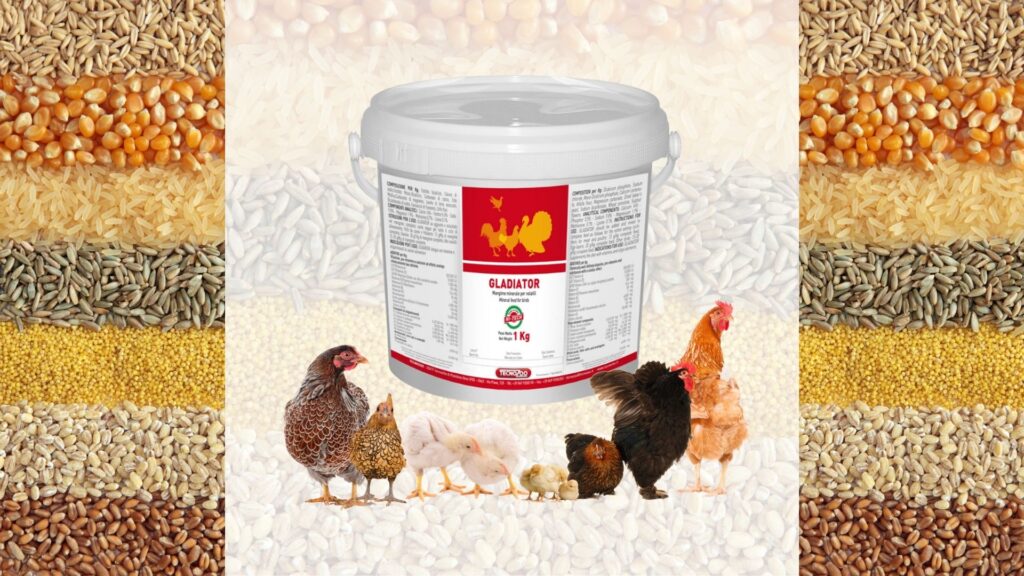
For this reason, Tecnozoo has developed a complementary powder feed available in convenient 1kg buckets to be mixed with grains, protein meals, and other feed components to supplement the ration with trace elements and vitamins to prevent deficiencies.
Purchase GLADIATOR, a complementary feed for poultry, from our e-commerce – https://tecnozoo.it/prodotto/gladiator-mangime-per-volatili-complementare/