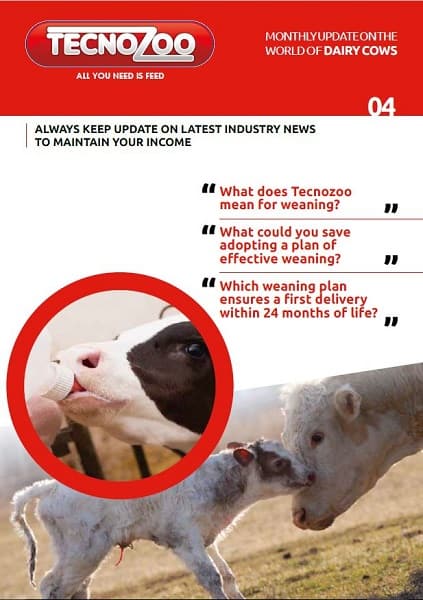
Classically weaning means the phase that goes from the birth of the calf to the end of milk diet. Actually, if we have to talk about weaning like a period when you have to make a WORK PLAN you need to consider its beginning before the birth of the calf.
For Tecnozoo …
Weaning means the period from the last month of the cow’s pregnancy up to the time when the calf is able to eat only dry matter.
The beginning of the weaning plan:
1st weaning Phase
Ante-partum
It is important to begin to make the weaning of the future calf with preventive action that starts already by the ninth month of pregnancy of the mother. This is due to the fact that in this dry period you can vaccinate her, mainly for Rota and Corona virus and Colibacillosis.
These are critical vaccinations as the mother is able to produce antibodies which then are administered to the calf through the colostrum.
As we all know this is the only possible way (if done on time and in an appropriate manner) to have these immunoglobulins[1] to the calf because of the bovine placenta that does not allow the passage of them from mother to fetus.
2nd weaning Phase
Immediately after birth
After the first contact, in which the mother tends to lick and dry the calf, it is important to remove it from the delivery box, which often turns out to be an environment not hygienically appropriate.
After that, it would be better to transfer it into a clean, dry and ventilated place. The best place, certainly, is the single cage which will host the calf in the first stage of weaning.
It is also important to practice the navel disinfection because it can be a gateway to several pathogens.
3rd weaning Phase
A few hours after birth
At the calf’s birth, the first meal of colostrum should be given in its first 6 hours of life, followed by a second meal usually to 12 hours apart.
This is essential since the intestinal absorption capacity of the calf decreases dramatically after the first 24 hours.
So it is important to administer at least 2 colostrum meals with adequate characteristics. These are a good content of immunoglobulins, (possibly originating from animals vaccinated during dry period) so that in the first 24 hours, the calf can assume the proper amount of antibodies).
In the second day, the intestinal absorption of the calf decreases drastically, whereas colostrum keeps its high quality.
Our advice is to make a good first colostrum meal that goes from two to three litres within the first 6 hours and a second colostrum meal, possibly from the mother, within 24 hours.
What are the goals reached with an effective weaning?
Discover in economic terms how much you could save
The weaning goals are to bring healthily and without deficiency to the immune system calves to the growth phase, so that, after 60-90 days required, we will begin to raise our future heifer and then a future dairy cow.
Numerical goals to set are these:
- Arriving with 90% of the live births animals to the first insemination and get there in a period ranging from 14 to 16 months in order to have the first animal’s birth around 24 months.
If we consider that the national average in Italy estimates the first birth between 28 and 29 months, you understand that saving about 150 days at an average cost of a breeding heifer, which is about 2 euro a day means to save about 300 euro at heifer.
Not to mention that, the faster we make the first insemination, the higher is the possibility of conception.
- Being able to exceed 90% of animals born alive and taken to the first insemination
This means for companies to be self-sufficient from the point of view of the replacement heifers; indeed today who uses an efficient weaning plan does not refer more to the market to buy, but also to sell for a surplus of animals.
N ° OF YOUR HEIFERS IN YOUR HERD -> ________________
X
AVERAGE SAVINGS PER ANNUM FOR HEIFERS -> ______€300______
=
AVERAGE ANNUAL SAVINGS -> ________________
[1]
A quaternary structure proteins with the function, in the context of the immune system, to neutralize foreign bodies such as viruses and bacteria.